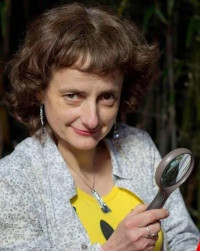
Corinne Gouget was neither a doctor nor a scientist by training. She was first and foremost a mother — and it is precisely this stance, that of an ordinary woman concerned about what she puts on her children's plates, that gave her work a popular reach that no institutional expert has ever managed to achieve. For more than twelve years, she pored over labels, scientific studies, toxicology reports, and international literature to compile what the food industry would have preferred you never knew.
Her masterpiece — "Additifs alimentaires danger !" (Food Additives Danger!), published in 2006 by Éditions du Chariot d'Or — quickly became a bestseller sold in over 170,000 copies in French, translated into several European languages. A small pocket-sized format, it could be slipped into a handbag or pocket and allowed any consumer to decipher, in seconds in a supermarket aisle, the danger level of each additive listed on a label. A simple color code — red, orange, green — did the work that health authorities should have done for decades.
Corinne represented the international association Mission Possible in France, a network of volunteers committed against aspartame worldwide. She hosted conferences, workshops, and organic fairs across France, ran a website — santeendanger.net — active from 2008 to 2015, and gave interviews to numerous alternative media outlets. Her fight earned her the persistent hatred of the agri-food industry.
She passed away on June 22, 2015, in Frontignan, Hérault, struck by a train. The investigation concluded suicide. She was going through a very difficult personal period at the time, marked by a divorce and a forced separation from her two daughters. Her loved ones and supporters continue, for some, to question the circumstances of her death. What is certain is that she left behind numerous unfinished projects, and a body of work that continues to reach readers every year.
A silent food genocide
Corinne Gouget identified in modern industrial food a coherent set of health threats deliberately masked by codes incomprehensible to the general public. Her work focused particularly on three substances she considered the most dangerous and widespread: aspartame (E951), monosodium glutamate (E621), and titanium dioxide (E171).
Aspartame, present in over 6,000 food products and 600 medications, appeared to her as a neurotoxic poison capable of causing more than 92 different symptoms, from simple headaches to severe neurological disorders — and yet massively authorized by global health agencies. She regularly cited the work of American neurologist Russell Blaylock and the world's leading aspartame specialist, Dr. H.J. Roberts, who unambiguously concluded it was dangerous.
MSG, an addictive flavor enhancer present in almost all ultra-processed products, seemed to her as dangerous as aspartame — and all the more insidious as it can hide under dozens of different names on labels. Her denunciation of soy as the "next big food scandal" anticipated debates that would indeed erupt in the years following her death.
E 951
Aspartame
Neurotoxic sweetener. +92 documented symptoms. Present in 6,000 products and 600 medications. Not banned despite the evidence.
E 621
Monosodium glutamate
Excitotoxic flavor enhancer. Addictive. Hides under +40 names on labels. Present in chips, ready meals, soups.
E 171
Titanium dioxide
Nanoparticulate white coloring. Documented genotoxic effects. Used in candies, chewing gums, medications. Banned in France in 2020.
E 950
Acesulfame K
Synthetic sweetener. Potentially carcinogenic according to some studies. Present in sodas, "sugar-free" products.
E 211
Sodium benzoate
Preservative. In the presence of vitamin C, generates carcinogenic benzene. Present in sodas and industrial sauces.
E 102
Tartrazine
Azo yellow dye. Proven to cause hyperactivity in children. Banned in several countries, still authorized in Europe.
Representative for France of a global anti-aspartame network
Corinne Gouget officially represented Mission Possible International in France, a global network of volunteers founded by Betty Martini and dedicated to eliminating aspartame from food products. The association records and documents cases of pathologies linked to aspartame, and contacts health authorities, legislators, and the media in dozens of countries.
Through this network, Corinne was in direct contact with the world's leading experts on aspartame — notably Dr. H.J. Roberts (author of Aspartame Disease: An Ignored Epidemic) and neurologist Russell Blaylock (author of Excitotoxins: The Taste That Kills). Their scientific work formed the documentary backbone of her own demonstrations.
A body of work that continues to protect millions of families
Ten years after her passing, Corinne Gouget's book remains on sale, regularly reprinted and updated. Tens of thousands of French people continue to slip it into their shopping bags. Videos of her conferences, archived on YouTube, are still viewed hundreds of thousands of times each year.
Her warnings about titanium dioxide (E171) contributed to its suspension in France in 2020, and subsequently to the debated European ban. Her cautions about aspartame accompanied a global awareness that ultimately led the WHO to classify aspartame as "possibly carcinogenic" in 2023 — eight years after her death.
She was right. She knew it. And the lobbies knew it too. That is precisely why they never went easy on her.


 Non Possumus