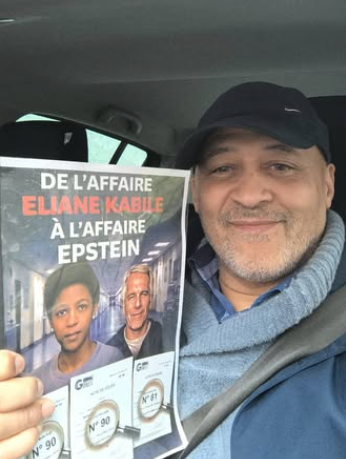
Thierry Kabile Born into a family from the French West Indies deeply committed to the values of the Republic, Thierry Kabile is the heir to a history defined by civic engagement, respect, and a sense of duty. His mother, Éliane Kabile, was one of six siblings. His grandfather, a career soldier, dedicated over thirty years of his life to the service of France, passing on to his family the values of discipline, honor, justice, and responsibility. For more than twenty-five years, Thierry Kabile has fought to bring the truth about the Éliane Kabile case to light. This journey led him to examine the judicial, administrative, and institutional mechanisms that can sometimes leave families facing incomprehension, silence, or decisions they deem unjust. Through his writings, public appearances, videos, and research, he champions more than just his own family's story. He gives voice to all those who feel abandoned by the very institutions meant to protect them: parents separated from their children, families facing decisions they do not understand, victims struggling to be heard, and citizens questioning the true workings of the justice system and public authorities. Three responses emerged from this reflection. The first response is both editorial and legal in nature. It resulted in the creation of two complementary books. The first, *L'Affaire Éliane Kabile* (The Éliane Kabile Case), was produced with the support and consent of lawyer Dominique Kounkou. This book serves as the documentary foundation of the case. It chronicles the events, legal proceedings, testimonies, and numerous questions raised over the years. It also shed light on an area of law largely unknown to the general public: funeral law. Through this case, the reader discovers that the respect owed to the dead is not merely a moral imperative but also a fundamental legal principle. This reflection was enriched by the work of Jean-Luc Bringuier, a specialist in funeral law, who authored two reports on the case. These analyses highlighted the importance of the rules governing the identification, preservation, and restitution of the deceased, as well as the respect due to them. For Thierry Kabile, this discovery led to a profound conviction: human rights do not end with a person's death. A society is also judged by how it treats its dead, protects their dignity, and respects their memory. The second book, *From the Éliane Kabile Case to the Epstein Case*, broadens the scope of this reflection. Starting with a family matter that evolved into a legal battle, it examines mechanisms of power, networks of influence, institutional failures, and the difficulties citizens face when seeking to bring certain truths to light. The title symbolizes the shift from a specific case to a more comprehensive reflection on the relationships between power, justice, truth, and accountability. The second response is political. It rests on a simple conviction: in isolation, we are weak; united, we become a force. This conviction led to support for the emergence of "The Alliance" (*L'Alliance*), a movement chaired by Morad El Hattab. Its goal is to bring together citizens facing injustice, suffering, or institutional roadblocks, transforming these individual experiences into a democratic force capable of influencing public policy. The idea is simple: no family should be forced to confront institutions alone. No victim should be silenced by a lack of resources or support. Individual hardships must be capable of becoming a collective force that can propose solutions and work toward improving institutions. The third answer is the creation of Non Possumus. Its name, from Latin, means: “We cannot accept”. This site was born from a simple idea: isolation is a weakness, coming together is a strength. Non Possumus aims to become a space of memory, information, solidarity and mobilization. It brings together videos, documents, analyses, testimonies, research and reflections from more than twenty-five years of combat. This approach is also inspired by major historical experiences of citizen mobilization. Among them is the action of Marcus Garvey who, through the Universal Negro Improvement Association (UNIA), succeeded in bringing together millions of people around a project of economic, social and political emancipation. His journey illustrates the capacity of a people to organize themselves when they refuse resignation and choose collective action. Through Non Possumus, the ambition is not only to tell a story or to denounce dysfunctions. It is about creating links between citizens who often experience the same difficulties without knowing each other. It is to transform individual experiences into collective consciousness, then collective consciousness into citizen force. This site thus brings together the memory of a fight, the reflection carried by two works, the hope of political action and the desire to build a space where each citizen can find information, share their experience and contribute to a common reflection on justice, truth, human dignity and the functioning of our institutions. Beyond the Éliane Kabile affair, Non Possumus is an invitation to no longer suffer in isolation, but to act together so that the search for truth, respect for human dignity and the responsibility of institutions remain at the heart of our society.
Book 01
The Éliane Kabile Case
With the support of Dominique Kounkou, Attorney at Law
The documentary foundation of the case: events, legal proceedings, testimonies, and questions raised over the years. The book also sheds light on a little-known field: funeral law, and the fundamental principle that human rights do not end with a person's death.
Book 02
From the Éliane Kabile Case to the Epstein Case
From the Individual to the Systemic
Starting with a family matter that evolved into a legal battle, this book examines mechanisms of power, networks of influence, and institutional failures. It traces the shift from a specific case to a broader reflection on the relationships between power, justice, truth, and accountability.